
Posts · J&K / Uttarakhand power projects
Sizing the power transformer for a new industrial estate in Jammu & Kashmir or Uttarakhand
Posted on by Jaybee Industries
The receiving substation of a new industrial estate is built once but must serve tenants who arrive over many years. Its power transformers need a sizing logic, not a round number.
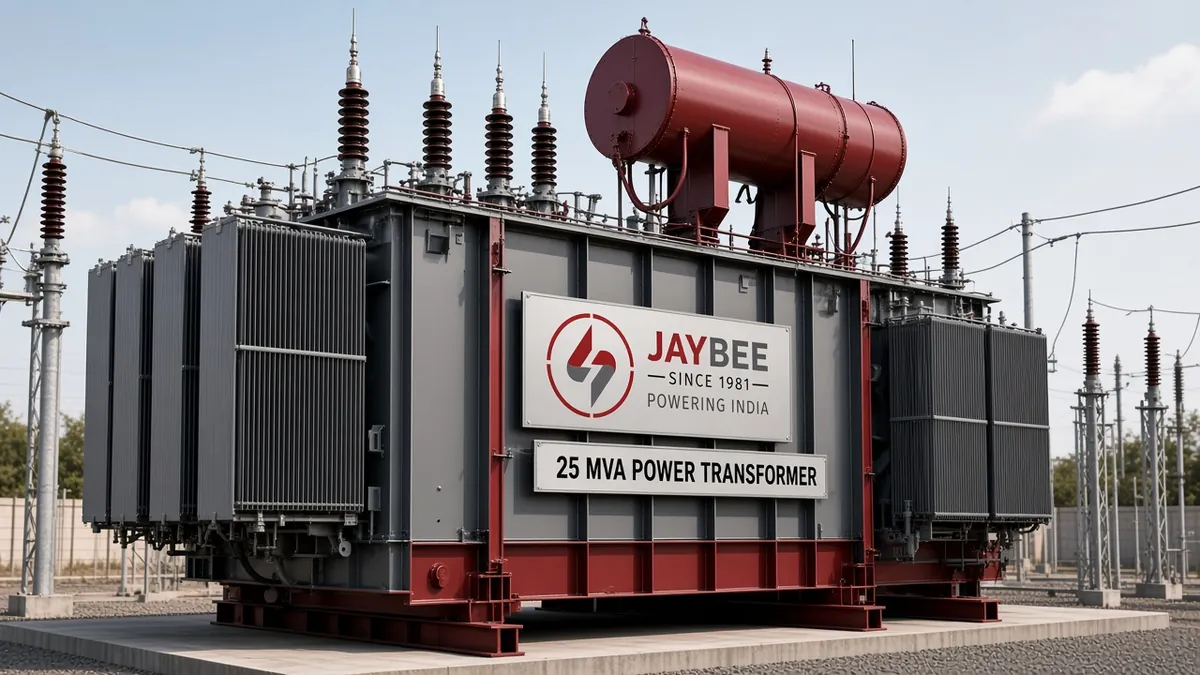
New industrial estates and expansions are being planned across Jammu & Kashmir and Uttarakhand, from the Jammu–Kathua–Samba belt to the plains of Haridwar and Udham Singh Nagar. Each estate needs a receiving substation that steps down from the transmission or sub-transmission voltage to the distribution voltage feeding the plots. Choosing the number and rating of the power transformers is one of the most consequential early decisions.
Build the demand curve
Start with the allotment plan: plot sizes, likely industry types and the expected order in which tenants will arrive. Apply realistic load densities for each industry type, and then diversity, because tenants will not all peak together. Plot the expected demand year by year. The power transformer arrangement should meet the first years comfortably and allow for the estate’s full build-out without wholesale replacement.
Redundancy: the N-1 question
Industrial tenants expect supply to continue if one transformer is out of service. The common approach is to install at least two transformers so that, if one fails or is under maintenance, the other can carry the essential load, perhaps with some short-term overload permitted. Whether the second unit must carry the full load or only a defined portion is a design choice that should be written into the specification.
Phasing the installation
A practical layout reserves bays and foundations for a final configuration, for example three transformers, while installing two at first. The third is added when demand reaches a trigger level. This keeps early capital and no-load losses lower without compromising future capacity. All units should have matching impedance, vector group and tap range so they can operate in parallel.
Impedance and fault levels
Transformer impedance sets the fault level on the downstream bus and affects voltage regulation. Too low, and the switchgear on the estate network must handle high fault currents; too high, and voltage drop under load increases. Agree impedance with the system designer, considering the switchgear rating planned for the estate.
Voltage regulation
Supply voltage at remote locations can vary considerably. An on-load tap changer allows the estate substation to keep the distribution voltage steady as load and supply change, and is usually justified for estate receiving substations. Our earlier note on OLTC basics for these regions explains the options.
Transport and site limits
Hill roads, bridges and turns can limit the size and weight that can reach a site. For locations beyond the plains, check the route before fixing the rating, because two smaller units may be easier to deliver than one large unit. Our guide on transporting power transformers on hill roads covers route surveys.
RFQ essentials
- Demand forecast and redundancy criteria.
- Primary and secondary voltages, vector group and impedance.
- Tap changer type and range.
- Cooling type and site ambient and altitude.
- Transport route constraints and testing requirements.
We prepare power transformer offers on request against your specification; we do not publish prices.
Send your enquiry
Call toll-free 1800 309 9948, message us on WhatsApp at +91 98162 95407, or email info@jaybeeindustries.com. Mention this article and your site location so the right team responds. We reply with technical options; we do not publish prices, and every offer is prepared for your specification.
Related pages on this site
- Power transformers
- Power transformer specification checklist
- Transporting power transformers on hill roads
- J&K and Uttarakhand
- Send a power transformer RFQ
Request a quote Call 1800 309 9948 WhatsApp +91 98162 95407 info@jaybeeindustries.com